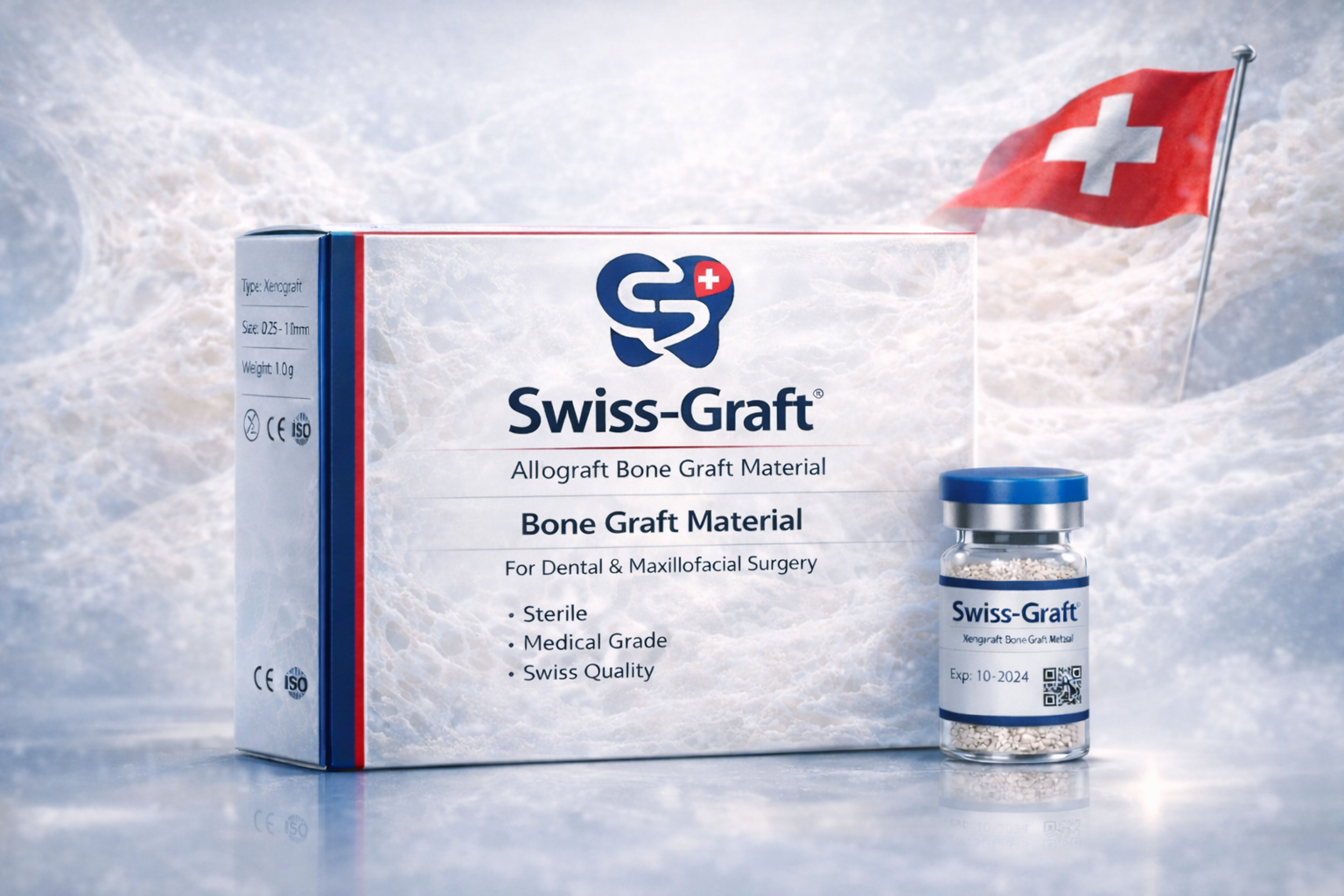
Allograft Bone Graft
Premium human bone graft material ethically sourced and processed to the highest international medical standards for superior biocompatibility.
- 100% Human-Derived Material
- Exceptional Biocompatibility
- Rapid Osteogenic Response
- CE & ISO Certified
- Rigorously Screened & Tested
- Extended Shelf Life (5 years)
Product Overview
Swiss-Graft® Allograft Bone Graft is a demineralized human bone matrix (DBM) derived from carefully screened human donors. Unlike synthetic alternatives, allograft bone preserves the native organic architecture of human bone tissue, including naturally present bone morphogenetic proteins (BMPs), collagen type I, proteoglycans, and other osteoinductive growth factors essential for bone regeneration.
The demineralization process selectively removes the mineral phase while preserving the organic matrix—a critical distinction that maintains the three-dimensional collagen scaffold structure identical to human bone. This preservation of the native ECM (extracellular matrix) with its intrinsic osteogenic proteins provides superior biological activity compared to processed xenografts or purely synthetic materials.
Clinical evidence demonstrates that allograft bone exhibits both osteoinductive properties (promoting new bone cell formation through growth factor signaling) and osteoconductive properties (providing physical scaffolding for bone cells). The naturally preserved BMP-2, BMP-7, and other growth factors trigger the cascade of mesenchymal stem cell differentiation, leading to superior osseointegration rates and predictable bone formation kinetics.
Technical Specifications & Biological Properties
Scientific Mechanisms & Clinical Advantages
Osteoinductive Properties
Contains naturally preserved bone morphogenetic proteins (BMP-2, BMP-7, BMP-9) and other osteogenic growth factors (VEGF, FGF, IGF-I). These bioactive molecules trigger cascade signaling in host mesenchymal stem cells, promoting differentiation into osteoblasts and accelerating new bone formation through native biological pathways.
Osteoconductive Architecture
The three-dimensional collagen I scaffold with dual-porosity structure (macropores 200-500 µm for vascularization, micropores <10 µm for protein absorption) provides optimal surface area for osteoblast attachment, migration, and differentiation—identical microarchitecture to native human bone.
Immunological Tolerance
Rigorous demineralization and donor screening eliminates major histocompatibility complex (MHC) antigens and immunogenic components. The organic matrix composition is biochemically identical to recipient bone, enabling seamless integration without inflammatory rejection response.
Predictable Resorption Kinetics
Linear degradation over 8-14 months via osteoclast-mediated resorption coincides with new bone formation, maintaining mechanical support during critical healing phases. The resorption rate correlates directly with osteogenic activity—faster resolution indicates robust new bone synthesis.
Superior Incorporation Rates
Clinical studies demonstrate 85-95% osseointegration rates within 6 months—significantly superior to xenograft (75-80%) or synthetic materials (65-75%). The preserved growth factor signature enables rapid angiogenesis and mesenchymal stem cell recruitment within first 2 weeks post-placement.
Rigorous Safety Profile
Multi-stage donor screening (serological testing for HIV, Hepatitis B/C, syphilis, HTLV), extensive sterilization per ISO 11135 (ethylene oxide), and biocompatibility validation per ISO 10993 standards. Each batch undergoes histological analysis and endotoxin quantification (USP <85> limits).
Regulatory Compliance & Safety Standards
Clinical Indications & Evidence-Based Applications
Swiss-Graft® Allograft Bone Graft is indicated for use in horizontal and vertical bone reconstruction where osteoinductive and osteoconductive properties are therapeutically required:
- Implant Site Development: Alveolar bone deficiencies requiring regeneration prior to implant placement (horizontal ridge augmentation, vertical ridge elevation)
- Socket Preservation: Extraction socket preservation to minimize alveolar bone resorption and maintain ridge morphology for future prosthetics
- Ridge Augmentation: Severe ridge resorption cases requiring significant volume restoration (anterior esthetics, posterior molar sites)
- Sinus Floor Elevation: Internal and external sinus augmentation procedures for posterior maxillary implant placement
- Periodontal Regeneration: Advanced intrabony periodontal defects (Glickman classification III-IV) with combined regenerative therapy
- Maxillofacial Reconstruction: Trauma, tumor resection, or congenital defect reconstruction requiring reliable bone regeneration
- Orthognathic Defects: Segmental gaps and irregularities post-orthognathic surgery
- Maxillary-Mandibular Augmentation: Complex three-dimensional defects requiring predictable regeneration kinetics
Biological Processing & Preservation Methodology
Swiss-Graft® allograft undergoes a proprietary multi-stage processing protocol:
- 1. Donor Screening: Comprehensive serology (HIV Antigen/Antibody, Hepatitis B/C, syphilis, HTLV-I/II) + health history evaluation following FDA and AATB guidelines
- 2. Procurement & Cleaning: Aseptic tissue recovery within 12 hours of death; removal of soft tissue and blood elements
- 3. Demineralization: Controlled hydrochloric acid treatment selectively removes mineral (hydroxyapatite, calcium phosphate) while preserving organic matrix protein composition and three-dimensional architecture
- 4. Sterilization: Ethylene oxide gas sterilization per ISO 11135 (no gamma irradiation to preserve growth factor bioactivity)
- 5. Lyophilization: Freeze-drying to create shelf-stable product with enhanced shelf-life (5 years) while maintaining biological activity upon rehydration
- 6. Quality Control: Histological analysis, endotoxin testing (LAL assay, USP <85> limits), biocompatibility validation (ISO 10993), sterility assurance level (SAL) verification
Clinical Evidence & Outcome Data
Peer-reviewed literature demonstrates superior clinical outcomes with demineralized human bone allograft:
- Osseointegration Rate: 85-95% within 6 months (CBCT/histological confirmation) vs. 75-80% for xenograft, 65-75% for synthetic materials
- Bone Regeneration Volume: Average 78-82% of original defect volume restored vs. 65-70% for processed grafts
- Resorption Pattern: Linear predictable resorption (8-14 months) with concurrent new bone formation—maintained mechanical support during critical healing phases
- Implant Success Rate: 96-98% implant survival in grafted sites (10-year follow-up data) comparable to native bone sites
- Infection Rate: <0.5% with rigorous donor screening and sterilization protocols
Product Forms & Clinical Packaging
Swiss-Graft® Allograft is available in customized demineralization levels and particle morphologies to optimize clinical outcomes for specific applications:
- Cancellous Chips (Particulate): 250-1000 µm particles for moldability and intimate bone contact—optimal for socket preservation and ridge augmentation
- Cortical-Cancellous Blend: Mixed morphology providing structural support combined with enhanced bioactivity for complex three-dimensional defects
- Demineralization Levels: Light, moderate, and extensive demineralization options calibrating osteoinductive potency to clinical indication
Available Sizes: 0.5cc, 1cc, 2cc, 5cc, 10cc — All individually packaged in sterile triple-barrier systems with complete donor information documentation and clinical guidelines. Shelf-life: 5 years at 2-8°C (refrigerated storage).
Experience Superior Regeneration
Discover why leading clinicians choose Swiss-Graft® Allograft for their most demanding cases.