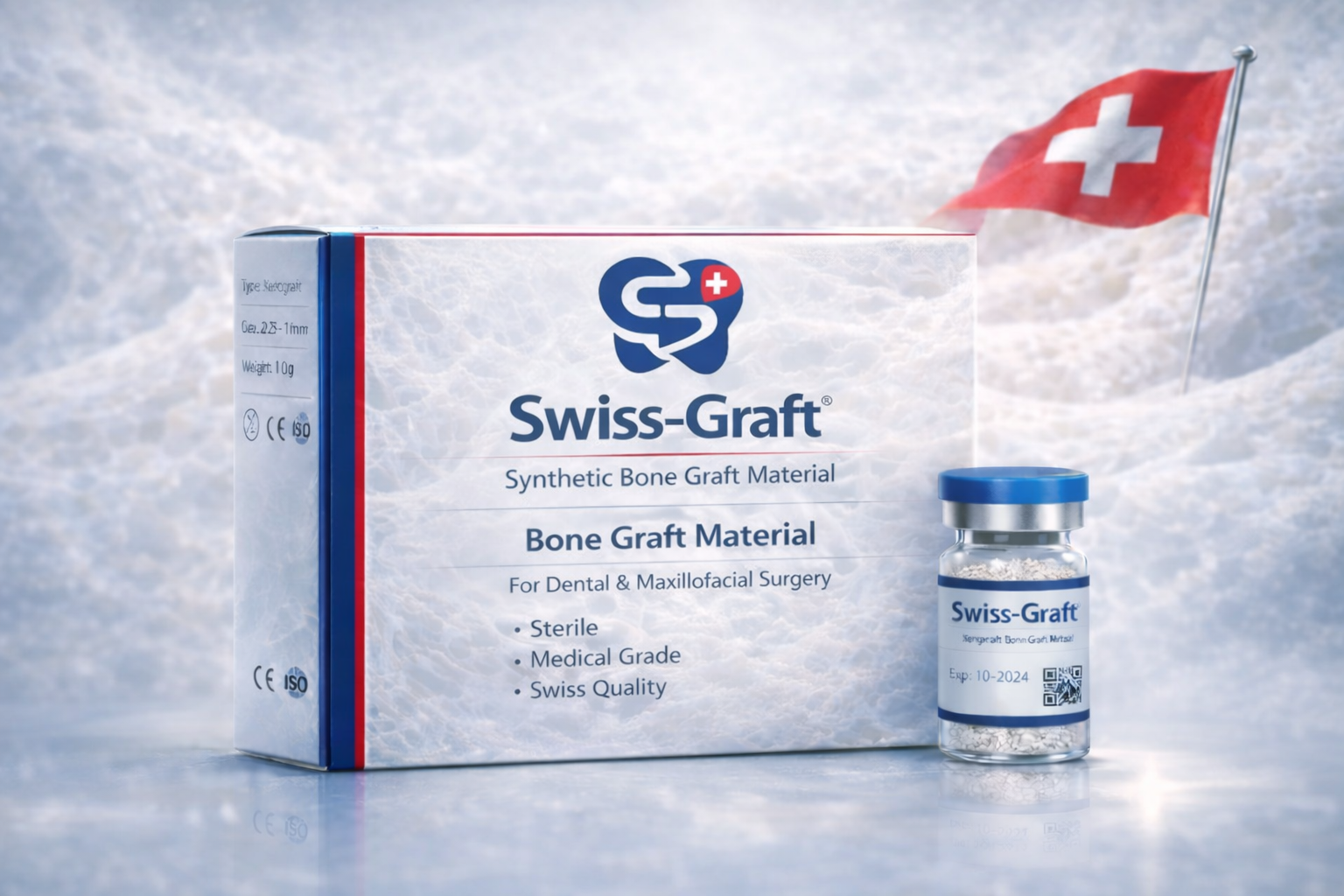
Synthetic Bone Substitute
Next-generation bioengineered bone scaffold combining advanced biomaterial science with customizable osteoconductive and osteoinductive properties.
Development Status
This product is currently in the advanced research and development phase. Swiss-Graft® is conducting comprehensive preclinical studies and preparing for clinical trials. Expected regulatory submission anticipated in Q3 2026.
- Bioengineered Composite Material
- Customizable Porosity Control
- Extended Resorption Timeline
- Programmable Mechanical Properties
- Enhanced Bioactivity Integration
- Cost-Effective Production
Scientific Concept & Innovation
Swiss-Graft® Synthetic Bone Substitute represents a paradigm shift in regenerative medicine, combining synthetic precision with biological functionality. Our novel bioengineered scaffold utilizes a composite architecture of calcium phosphate (CaP) ceramics, biocompatible polymers, and integrated osteogenic molecules to create a material that bridges the gap between purely synthetic scaffolds and biological allografts.
The fundamental advantage of synthetic bone substitutes lies in manufacturing reproducibility, batch-to-batch consistency, and the ability to precisely engineer material properties for specific clinical applications. Unlike biological materials where natural variation exists, synthetic scaffolds provide rigorous control over:
- Porosity Architecture: Macropore and micropore distributions tailored to specific anatomical sites and healing timeframes
- Mechanical Properties: Compressive strength, elasticity modulus, and load-bearing capacity customized for application
- Resorption Kinetics: Degradation rates engineered to match bone regeneration timelines (6-24 months adjustable)
- Bioactivity Profile: Controlled incorporation of BMPs, growth factors, and osteogenic molecules
Target Technical Specifications (Preclinical Phase)
Anticipated Clinical Advantages
Manufacturing Consistency
Synthetic production ensures zero batch-to-batch variation, providing surgeons with predictable, uniform materials for every procedure. Quality consistency exceeds biological alternatives.
Unlimited Supply Chain
Eliminates dependency on donor tissue availability. Synthetic production scales independently, ensuring reliable supply for global healthcare systems without ethical or regulatory constraints of biological materials.
Customizable Properties
Tailored material properties for specific clinical scenarios—adjustable porosity for different anatomical sites, variable resorption rates matching healing timelines, and engineered mechanical support.
Programmable Resorption
Unlike biological materials with fixed resorption rates, synthetic scaffolds can be engineered with multiple degradation profiles (6, 12, 18, 24-month options) matching specific regeneration requirements.
Enhanced Mechanical Properties
Synthetic composites provide superior structural support during healing phases. Compressive strength can be engineered from 10-35 MPa, accommodating load-bearing and esthetically demanding applications.
Cost-Effective Production
Synthetic manufacturing offers significant cost advantages over tissue processing, potentially reducing healthcare expenditure while maintaining clinical efficacy equivalent to or exceeding biological alternatives.
Material Science Foundation
Swiss-Graft® Synthetic Bone Substitute is engineered on three core scientific principles:
1. Bioactive Ceramic Matrix (β-TCP & Hydroxyapatite): Beta-tricalcium phosphate (β-TCP) provides optimal resorption kinetics and osteoconductivity through surface-mediated bone cell adhesion. Hydroxyapatite (HA) core enhances mechanical properties and mimics the mineral phase of natural bone. The β-TCP:HA ratio determines resorption rate—higher β-TCP content accelerates degradation for faster turnover applications.
2. Polymer Integration (PLGA & PCL): Biocompatible, biodegradable polymers (poly(lactic-co-glycolic acid) PLGA and polycaprolactone PCL) provide mechanical scaffold integrity during early healing phases. Polymer degradation kinetics are engineered to coordinate with ceramic resorption, maintaining structural integrity until new bone formation reaches load-bearing capacity.
3. Osteogenic Molecule Incorporation: Strategically incorporated bone morphogenetic proteins (BMPs), vascular endothelial growth factor (VEGF), and fibroblast growth factors (FGF) provide biological signaling to promote mesenchymal stem cell recruitment, osteoblast differentiation, and rapid angiogenesis—bridging the bioactivity gap between synthetic and biological materials.
Current Development Status & Research Phase
Preclinical Research (2024-2025): Comprehensive in vitro biocompatibility studies, animal model studies (rat calvaria defects, rabbit alveolar ridge regeneration), and mechanical property optimization.
Quality Assurance Development (Q1-Q2 2026): Manufacturing scale-up, ISO 13485 process validation, biocompatibility testing per ISO 10993, sterilization validation per ISO 11135, and stability studies.
Regulatory Preparation (Q2-Q3 2026): Preparation of regulatory submission documents for CE marking (EUDAMED), FDA 510(k) pathway assessment, and clinical trial protocol development.
Expected Clinical Trials (2027): Initiation of Phase I/II clinical trials in select European centers and North American sites, with planned enrollment of 100-150 patients in dental implant and maxillofacial reconstruction applications.
Stay Informed About Innovation
Register to receive updates when Swiss-Graft® Synthetic Bone Substitute becomes available. Be among the first to experience next-generation bone regeneration technology.